

Fluorinated Bottle Market to Reach USD 3.5 Billion by 2035 Driven by Agrochemical and Pharmaceutical Packaging Demand
Fluorinated Bottle Market
USA fluorinated bottles market grow at 6.2% CAGR, driven by specialty chemical, pharma packaging and rising demand for high-performance agrochemical containers.
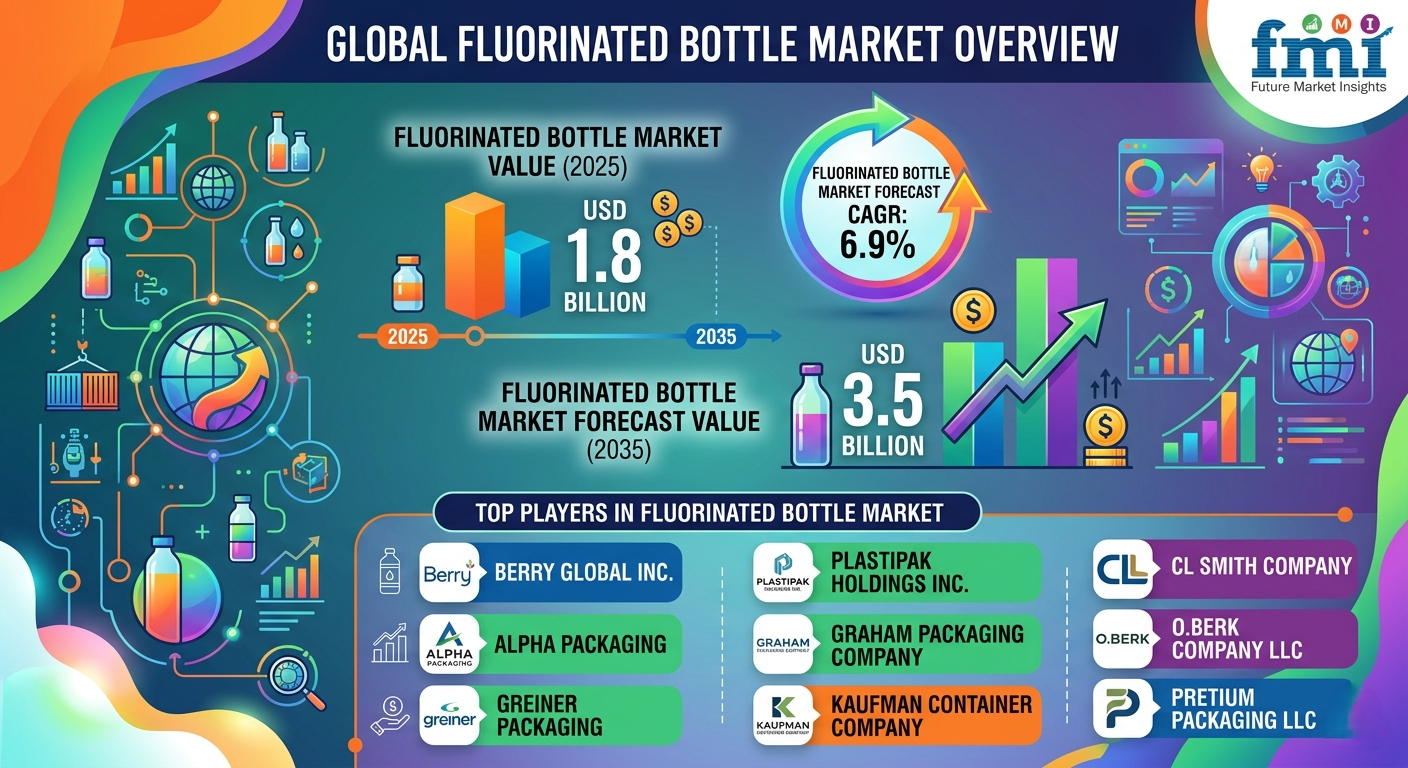
NEWARK, DE, UNITED STATES, April 1, 2026 /EINPresswire.com/ -- The global fluorinated bottle market is projected to grow from USD 1.8 billion in 2025 to USD 3.5 billion by 2035, expanding at a compound annual growth rate (CAGR) of 6.9%. The market expansion is being driven by increasing demand for high-barrier chemical-resistant packaging across agrochemicals, pharmaceuticals, industrial chemicals, and specialty fluid applications where product stability and contamination prevention are critical.
The growth trajectory reflects structural changes in chemical packaging and pharmaceutical storage systems, where fluorinated bottles are increasingly replacing conventional plastic containers due to superior barrier performance, permeation resistance, and regulatory compliance advantages.
Quick Stats – Fluorinated Bottle Market
• Fluorinated Bottle Market Value (2025): USD 1.8 billion
• Fluorinated Bottle Market Forecast Value (2035): USD 3.5 billion
• Fluorinated Bottle Market Forecast CAGR (2025–2035): 6.9%
• Leading Application Segment: Agrochemicals (42.3%)
Discover Growth Opportunities in the Market – Get Your Sample Report Now
https://www.futuremarketinsights.com/reports/sample/rep-gb-16377
Market Overview and Growth Outlook (2025–2035)
Between 2025 and 2030, the fluorinated bottle market is expected to reach USD 2.5 billion, contributing approximately 41.2% of total decade growth. The remaining 58.8% growth is expected between 2030 and 2035, driven by the integration of ultra-high barrier technologies, specialized fluoropolymer coatings, and advanced surface treatment technologies for pharmaceutical and semiconductor-grade chemical applications.
Fluorinated bottles are widely used in industries that require protection against oxygen, moisture, UV light, and chemical permeation. These bottles are increasingly used in packaging for agrochemicals, pharmaceutical intermediates, specialty chemicals, and industrial fluids, where formulation stability and shelf-life performance are critical.
Market Segmentation and Material Trends
Material segmentation highlights the dominance of fluorinated HDPE bottles, which hold approximately 60% market share due to their superior chemical resistance and strong acceptance in pharmaceutical and chemical packaging workflows. Fluorinated PET bottles account for roughly 25% share, primarily used in applications requiring transparency, visual inspection, or UV protection in laboratory and analytical environments.
By application, pharmaceutical packaging accounts for approximately 50% of demand, followed by laboratory and analytical applications at around 30%, and specialty chemicals at approximately 15%. Agrochemicals represent a major end-use segment overall, accounting for 42.3% of total demand in 2025.
The 500ml–1L capacity segment is projected to account for 36.8% of the fluorinated bottle market in 2025, driven by its compatibility with pesticide concentrate packaging, pharmaceutical intermediate storage, and specialty chemical packaging formats.
Key Growth Drivers in the Fluorinated Bottle Market
The fluorinated bottle market is growing due to increasing demand for chemical-resistant packaging solutions that can protect formulation quality, prevent permeation losses, and ensure product stability across complex distribution networks.
Key growth drivers include:
• Increasing global agrochemical production and pesticide consumption
• Expansion of pharmaceutical intermediate manufacturing
• Growing demand for chemical-resistant packaging
• Increasing regulatory requirements for chemical storage and transport
• Adoption of barrier packaging technologies
• Demand for contamination prevention and extended shelf-life packaging
• Growth in specialty chemical manufacturing
• Expansion of high-purity chemical storage applications
Modern chemical manufacturers and agrochemical producers are increasingly adopting fluorinated bottles to ensure formulation stability, regulatory compliance, and improved storage performance.
Technology Trends and Innovation in Fluorinated Bottles
The market is experiencing technological advancements in fluorination processing technologies, including plasma fluorination, gas phase fluorination, and surface treatment technologies that improve barrier performance and chemical compatibility.
Manufacturers are also integrating multi-layer barrier systems, co-extrusion technologies, and hybrid barrier solutions to enhance chemical resistance, reduce permeation loss, and improve product stability during storage and transportation.
These innovations are enabling fluorinated bottles to move beyond traditional chemical packaging and into pharmaceutical, laboratory, and specialty chemical applications requiring ultra-high barrier performance.
Regional Market Analysis and Country Growth Trends
The fluorinated bottle market is experiencing strong growth across Asia Pacific, North America, and Europe. India is projected to be the fastest-growing market with a CAGR of 8.9% through 2035, driven by expanding agrochemical production, pharmaceutical manufacturing, and chemical packaging infrastructure development.
China is expected to grow at 7.8%, supported by rapid agrochemical production expansion and increasing export packaging demand. The United States is projected to grow at 6.2%, driven by specialty chemical innovation and pharmaceutical packaging demand. Brazil is expected to grow at 7.4%, supported by agricultural chemical production expansion.
Germany, Japan, and France are expected to grow at 5.8%, 5.3%, and 6.1% respectively, driven by pharmaceutical packaging, specialty chemical manufacturing, and advanced barrier packaging technologies.
Europe’s fluorinated bottle market is expected to grow from USD 0.5 billion in 2025 to USD 1.0 billion by 2035, representing a CAGR of 7.2%.
Competitive Landscape and Key Companies
The fluorinated bottle market is moderately consolidated, with major packaging manufacturers and container suppliers focusing on fluorination technology, lightweight bottle designs, and improved barrier performance.
Leading companies operating in the fluorinated bottle market include:
• Berry Global Inc.
• Alpha Packaging
• Greiner Packaging
• Plastipak Holdings Inc.
• Graham Packaging Company
• Kaufman Container Company
• CL Smith Company
• O.Berk Company LLC
• Pretium Packaging LLC
• SKS Bottle & Packaging Inc.
Large manufacturers are focusing on in-house fluorination technologies and high-performance container manufacturing, while mid-sized companies are expanding custom fluorinated bottle offerings for agrochemicals, automotive fluids, and specialty chemical packaging applications.
Distributors and packaging solution providers play an important role in supplying small and mid-volume customers with fluorinated HDPE bottle formats, custom labeling, and flexible ordering programs.
Market Opportunities and Strategic Growth Pathways
The fluorinated bottle market presents multiple growth opportunities across high-barrier packaging technologies, pharmaceutical container systems, custom fluorination services, and lightweight bottle designs.
Major opportunity areas include:
• High-barrier bottles for specialty agrochemicals
• Pharmaceutical-grade fluorinated containers
• Custom fluorination surface treatment services
• Lightweight and material-optimized bottle designs
• Regional manufacturing expansion in Asia Pacific
• Multi-layer barrier technology integration
• Industrial chemical and solvent packaging
Geographic expansion and local manufacturing capabilities are expected to play a major role in market growth, particularly in India, China, and Southeast Asia, where agrochemical production and chemical manufacturing are expanding rapidly.
Market Drivers, Restraints, and Industry Trends
The fluorinated bottle market is being driven by increasing demand for chemical-resistant packaging, regulatory compliance requirements, and the need for extended shelf-life packaging solutions.
However, the market also faces challenges, including high fluorination processing costs, competition from alternative barrier technologies, and the need for specialized fluorination equipment investment.
Despite these challenges, increasing adoption of plasma fluorination, multi-layer barrier systems, and hybrid barrier technologies is expected to support long-term market growth.
Why FMI: https://www.futuremarketinsights.com/why-fmi
Explore More Research Reports by FMI
Recycled Polyethylene Terephthalate (rPET) Market - https://www.futuremarketinsights.com/reports/recycled-polyethylene-terephthalate-packaging-market
PET Bottles Market - https://www.futuremarketinsights.com/reports/pet-bottles-market
PDCL Film Market - https://www.futuremarketinsights.com/reports/pdcl-film-market
Bi-Injected Snap Hinge Closure Market - https://www.futuremarketinsights.com/reports/bi-injected-snap-hinge-closure-market
Spout Pouch Market - https://www.futuremarketinsights.com/reports/spout-pouches-market
About Future Market Insights (FMI)
Future Market Insights, Inc. (FMI) is an ESOMAR-certified, ISO 9001:2015 market research and consulting organization, trusted by Fortune 500 clients and global enterprises. With operations in the U.S., UK, India, and Dubai, FMI provides data-backed insights and strategic intelligence across 30+ industries and 1200 markets worldwide.
Sudip Saha
Future Market Insights Inc.
+1 347-918-3531
rahul.singh@futuremarketinsights.com
Legal Disclaimer:
EIN Presswire provides this news content "as is" without warranty of any kind. We do not accept any responsibility or liability for the accuracy, content, images, videos, licenses, completeness, legality, or reliability of the information contained in this article. If you have any complaints or copyright issues related to this article, kindly contact the author above.
