

South Korea Smart Camera Market Led by Sony, Hanwha Vision, and Bosch as AI Monitoring Expands
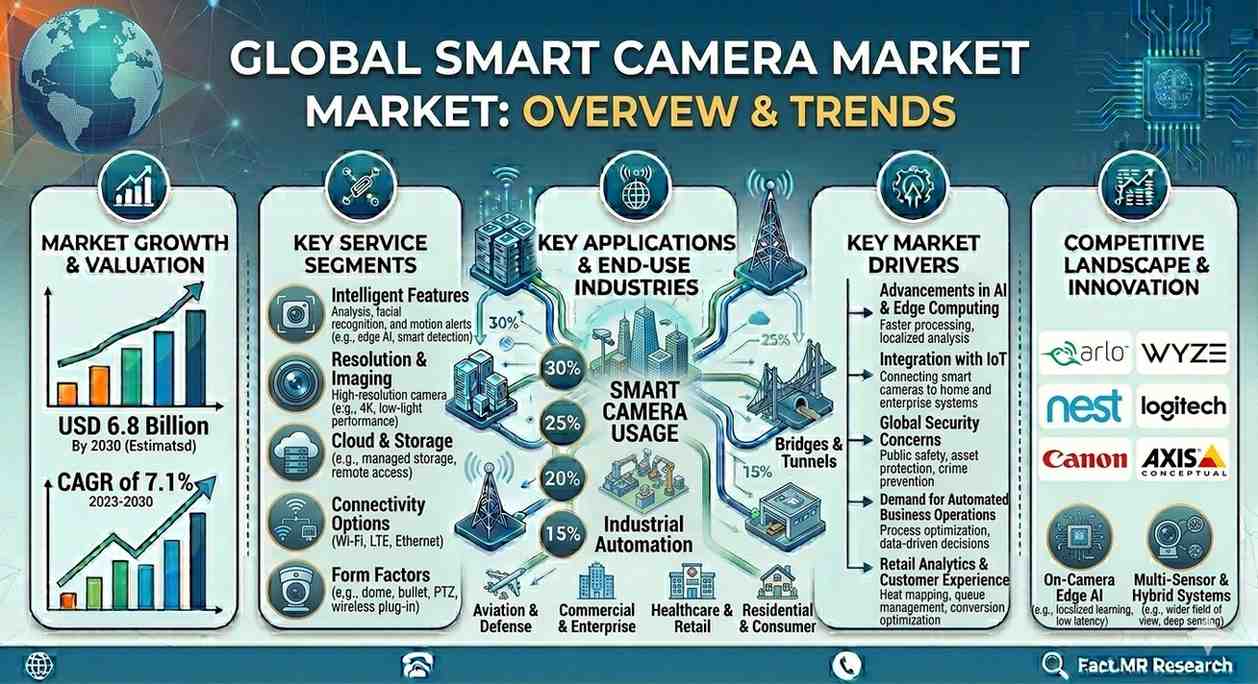
Smart Camera Market
Automotive safety and automation boost South Korea’s AI smart camera adoption.
ROCKVILLE, MD, UNITED STATES, April 10, 2026 /EINPresswire.com/ -- According to Fact.MR’s latest analysis, the South Korea smart camera market is witnessing strong growth as AI-enabled imaging systems gain traction across transportation, automotive, manufacturing, and public safety applications. The global smart camera industry, valued at USD 45.9 billion in 2025, continues to expand, with South Korea projected to grow at a CAGR of 8.8% between 2026 and 2036.The market is benefiting from government-backed infrastructure digitization, increased deployment of AI traffic monitoring cameras, and growing demand for ADAS-enabled automotive imaging systems. Incremental opportunities are emerging from smart city deployments, industrial automation, and embedded edge AI capabilities transforming traditional surveillance devices into intelligent sensing platforms.
Get detailed market forecasts, competitive benchmarking, and pricing trends:
https://www.factmr.com/connectus/sample?flag=S&rep_id=14552
Quick Stats
Market Size (2025 – Global Reference): USD 45.9 Billion
Market Size (2026 – Expansion Phase): Continued AI camera adoption growth
Forecast Value (2036): Strong AI-enabled vision expansion
South Korea CAGR (2026–2036): 8.8%
Incremental Opportunity: Smart city and ADAS deployment growth
Leading Segment: Image Sensors (~37% share)
Leading Application: Transportation & Automotive (~38% share)
Leading Region: South Korea (Country-focused analysis)
Key Players: Sony Corporation, Hanwha Vision, Bosch Security Systems, Axis Communications, Hikvision
Executive Insight for Decision Makers
South Korea’s smart camera market is shifting from basic surveillance hardware to AI-enabled analytics platforms. Cameras are increasingly embedded with neural processors, enabling on-device decision-making and reducing latency.
Strategic priorities:
Integrate AI inference chips and neural processing units
Focus on ADAS and transportation camera deployments
Develop industry-specific analytics software
Ensure compliance with security and privacy regulations
Failure to invest in AI-enabled smart cameras may result in reduced competitiveness, lower pricing power, and limited participation in large infrastructure projects.
Market Dynamics
Key Growth Drivers
Smart city traffic monitoring deployments
Automotive ADAS mandates increasing camera content per vehicle
Industrial automation demand for machine vision
Government digital infrastructure investment
Key Restraints
High initial deployment cost for AI cameras
Data privacy and surveillance regulations
Integration challenges with legacy systems
Emerging Trends
Edge AI processing in cameras
Multi-camera ADAS architectures
AI-based industrial inspection
Smart healthcare monitoring cameras
Segment Analysis
By Component
Image sensors lead with ~37% share
Sensor quality directly impacts AI detection accuracy
Growth driven by automotive and surveillance demand
By Application
Transportation and automotive hold ~38% share
ADAS camera deployment increasing per vehicle
Fastest Growing Segment
AI-enabled traffic monitoring cameras
Strategic Importance
Image sensors define camera performance
Automotive applications generate high-volume demand
Industrial machine vision drives premium pricing
Supply Chain Analysis (VERY IMPORTANT)
Raw Material Suppliers
Semiconductor wafer providers
CMOS image sensor manufacturers
Lens and optics suppliers
AI chip and processor vendors
Manufacturers / Producers
Smart camera OEMs
Automotive camera module manufacturers
Industrial machine vision solution providers
Distributors
System integrators
Security infrastructure providers
Automotive electronics suppliers
End Users
Transportation authorities
Automotive OEMs
Manufacturing plants
Healthcare facilities
Smart city administrators
Who Supplies Whom
Sensor and chip suppliers provide components to camera OEMs
OEMs assemble smart cameras with embedded AI processing
System integrators deploy solutions for city and industrial clients
End-users operate cameras for monitoring, automation, and analytics
Pricing Trends
Standard surveillance cameras follow commodity pricing
AI-enabled smart cameras command premium pricing
Pricing influenced by:
AI processing capability
Sensor resolution and performance
Compliance certifications
Software analytics features
Vendors generate recurring revenue via analytics software licensing
Regional Analysis (South Korea Focus)
South Korea – CAGR 8.8%
Digital New Deal funding supporting AI traffic monitoring
Automotive electronics demand from domestic OEMs
Smart city surveillance expansion
Industrial automation adoption
Developed vs Emerging Market Comparison
South Korea emphasizes AI-enabled premium cameras
Higher adoption in transportation and automotive sectors
Strong integration with smart infrastructure
Competitive Landscape
The South Korea smart camera market is moderately consolidated, with technology-driven competition focusing on AI integration and sensor innovation.
Key Players
Sony Corporation
Bosch Security Systems
Hanwha Vision
Axis Communications
Hikvision Digital Technology
Dahua Technology
FLIR Systems
Avigilon (Motorola Solutions)
Honeywell Security
Panasonic i-PRO
Competitive Strategies
AI chip integration
Automotive partnerships
Smart city project participation
Edge analytics development
Compliance-focused product offerings
Strategic Takeaways
For Manufacturers
Integrate neural processing units
Develop AI analytics software
Target transportation and automotive segments
For Investors
Growth driven by ADAS camera adoption
Smart city infrastructure offers long-term demand
Edge AI technology creates premium margins
For Marketers / Distributors
Position cameras as AI analytics platforms
Target government smart infrastructure projects
Emphasize automation and efficiency benefits
Future Outlook
South Korea’s smart camera market is expected to evolve toward AI-powered vision ecosystems integrated with smart cities, autonomous vehicles, and industrial automation.
Growth in multi-camera automotive systems
Edge AI processing adoption
Smart city analytics deployment
Integration with IoT and 5G infrastructure
Long-term opportunities exist in ADAS cameras, industrial inspection, and public safety analytics.
Conclusion
The South Korea smart camera market is transitioning from traditional surveillance to intelligent vision platforms. Government investments, automotive safety requirements, and industrial automation are creating strong growth momentum. Companies focusing on AI-enabled imaging, compliance, and system integration will capture significant market opportunities.
Why This Market Matters
South Korea’s advanced electronics manufacturing base and smart infrastructure initiatives position it as a strategic growth hub for AI-enabled smart camera technologies. As automation and intelligent monitoring expand, the market offers substantial opportunities for OEMs, investors, and technology providers.
Full Report: Unlock 360° insights for strategic decision making and investment planning-
https://www.factmr.com/checkout/14552
To View Related Report:
Smart Education and Learning Market https://www.factmr.com/report/smart-education-and-learning-market
Smart Agriculture Solution Market https://www.factmr.com/report/smart-agriculture-solution-market
Smart Personal Safety and Security Device Market https://www.factmr.com/report/smart-personal-safety-and-security-device-market
Smart Indoor Gardening System Market https://www.factmr.com/report/smart-indoor-gardening-system-market
S. N. Jha
Fact.MR
+1 628-251-1583
email us here
Legal Disclaimer:
EIN Presswire provides this news content "as is" without warranty of any kind. We do not accept any responsibility or liability for the accuracy, content, images, videos, licenses, completeness, legality, or reliability of the information contained in this article. If you have any complaints or copyright issues related to this article, kindly contact the author above.
