

Your top news on business and economy
Provided by AGP
Cowlitz Indian Tribe Launches Baby Beaver Livestream
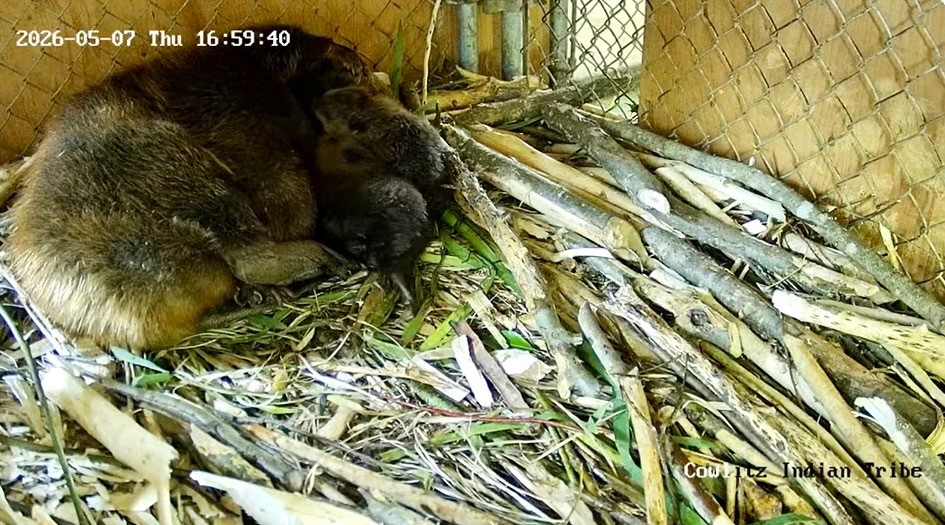
Still image taken from Cowlitz "Kit Cam" livestream
The Cowlitz “Kit Cam” livestream highlights the Tribe’s leading beaver relocation program
LONGVIEW, WA, UNITED STATES, May 11, 2026 /EINPresswire.com/ -- The Cowlitz Indian Tribe announced the launch of a new livestream featuring a young beaver family as it prepares for relocation and release into the wild. The Cowlitz “Kit Cam” lets viewers observe four baby beavers (known as “kits”) born on April 16, 2026, and their mother in real-time as they grow and learn behaviors essential to survival.This unique opportunity is being offered by the Tribe’s ongoing beaver relocation program which is the largest of its kind in Washington State, and one of the largest in the Western United States. Each year, the program relocates approximately 70 beavers, representing 20 to 30 family groups, from areas of human-wildlife conflict to areas suitable for beaver habitat.
“As Cowlitz people, we have always understood our responsibility to care for the land and the resources it provides,” said Cowlitz Indian Tribe Chairman Bill Iyall. “This program is one way we are putting that responsibility into action—restoring balance to our ancestral homelands and waterways, and planning for the generations that come after us.”
Beaver populations were significantly reduced by commercial fur trapping and eradication efforts during early colonization, and their habitat was severely degraded by subsequent land use practice changes in the late 1800’s. Today, beaver populations in many areas remain below desired levels. As a foundation species, beavers help restore wetlands, improve water quality, increase drought resilience, and create habitat for fish and wildlife.
“Beavers are amazing ecosystem engineers and create high quality complex wetland habitats that support biodiversity and ecosystem properties that can help buffer projected impacts of climate change,” said Jesse Burgher, Wildlife Program Manager. “We’re finding a lot of evidence that suggests beavers once occupied many areas of the Cascade Range of Southwest Washington and are taking efforts to rebuild beaver populations to restore critical freshwater resources and ecosystems across the landscape.”
Beavers that enter the program are brought by wildlife professionals to the Tribe’s beaver husbandry facility on the Cowlitz reservation and held while additional family members are safely captured—an approach that improves relocation success. As a permitted beaver relocator in partnership with the Washington Department of Fish and Wildlife’s Beaver Relocation Permit Program, beavers are typically held for 7 to 10 days before relocation. Once a family group is complete, they are released into pre-identified suitable habitats, followed by post-release monitoring to track relocation success and habitat outcomes.
By relocating beavers into suitable environments, the Tribe is helping to restore these natural ecosystem processes while reducing conflict in more developed areas.
The livestream will be available until the four baby beavers are successfully released into the wild.
For questions about the Cowlitz Indian Tribe’s beaver relocation program, Jesse A.S. Burgher, Ph.D. Wildlife Program Manager, jburgher@cowlitz.org.
Madison Hitchcock
Cowlitz Indian Tribe
+1 206-450-2849
email us here
Legal Disclaimer:
EIN Presswire provides this news content "as is" without warranty of any kind. We do not accept any responsibility or liability for the accuracy, content, images, videos, licenses, completeness, legality, or reliability of the information contained in this article. If you have any complaints or copyright issues related to this article, kindly contact the author above.
